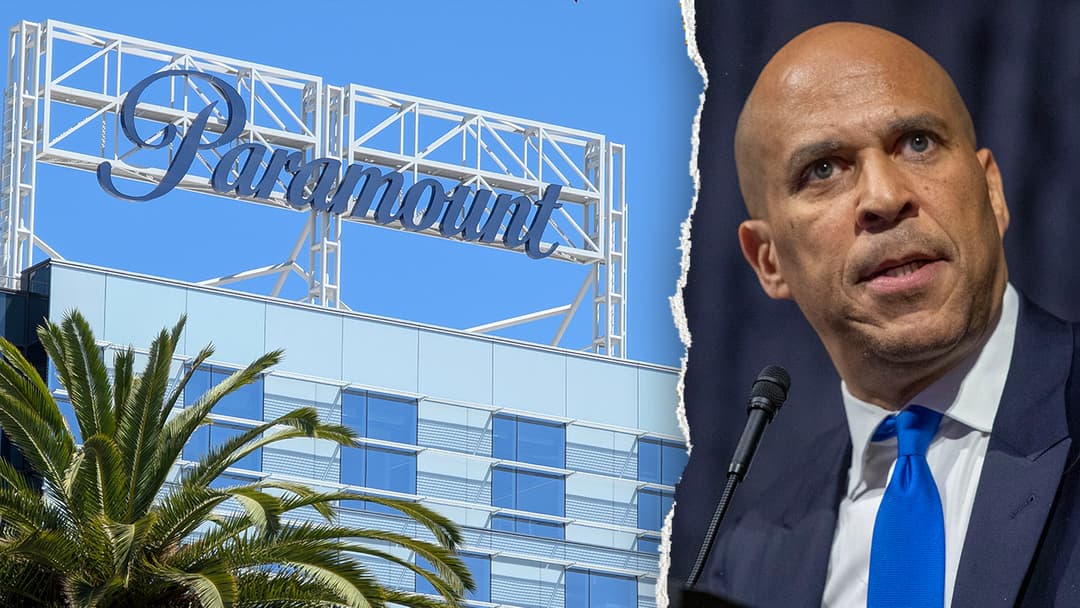
Three Democratic senators have urged the Federal Communications Commission (FCC) to put the Paramount-Warner Bros. Discovery merger on pause over concerns about foreign investors controlling what would be one of the largest media companies in the United States.
In a joint letter to FCC Chairman Brendan Carr, Sens. Cory Booker, D- N.J., Adam Schiff, D-Calif., and Elizabeth Warren, D-Mass., demanded he "must foreclose any attempt by Paramount to close this transaction" before an adequate review of the involved foreign investors is completed.
The lawmakers said the FCC must conduct this review to evaluate possible "national security threats posed by foreign government investment" in the $110 billion entity. If approved, the merger would bring CNN and CBS News under one corporate owner, further consolidating the news media landscape.
Paramount, led by CEO David Ellison, acknowledged in an April financial disclosure cited by the senators that foreign ownership in the new corporation will rise to "approximately 49.5 percent." In that document, Paramount also said that all voting rights will be "controlled by the Ellison family through U.S. entities."
WARNER BROS DISCOVERY SHAREHOLDERS APPROVE PARAMOUNT SKYDANCE DEAL
The document revealed that Saudi Arabia's public investment fund and various entities based in the United Arab Emirates and Qatar would be equity holders.
Paramount told the FCC in April that this arrangement would not present "any national security, law enforcement, or foreign or trade policy concerns."
The senators want a more rigorous check of what this level of foreign ownership would mean, telling Carr in their letter that he should not take the Ellison family's statements "at face value."
They argued that the FCC should reject Paramount's petition for preemptive approval. Under Section 310 of the 1934 Communications Act, foreign individuals, companies and governments are generally prohibited from owning more than 25% of a U.S.-based firm that has an FCC-issued broadcast license.
Booker, Schiff and Warren gave Carr a July 1 deadline to notify Paramount that the deal cannot close until the foreign investment review is completed.
The FCC's pending approval is the largest regulatory hurdle in the way of the merger. The Department of Justice signaled last week it would not challenge Paramount's bid to acquire Warner Bros.
The DOJ's antitrust division concluded after an eight-month review that "the transaction is not likely to result in harm to competition or American consumers" with regard to on-demand streaming, linear television and studio development, and the production and distribution of films.
Warren criticized this decision by the DOJ and urged state attorneys general to continue fighting the transaction. California Attorney General Rob Bonta was already leading a coalition of states in preparing a lawsuit to block Paramount from adding Warner Bros. to its growing portfolio.
More than 5,000 filmmakers and actors working in Hollywood signed an open letter in April furiously demanding that the merger be stopped. They argued that it would stifle competition and reduce job opportunities.
"Our industry is already under severe strain, in large part due to prior waves of consolidation. We have witnessed a steep decline in the number of films produced and released," according to the petition. "We are deeply concerned by indications of support for this merger that prioritize the interests of a small group of powerful stakeholders over the broader public good."